What Improves Results in Night Photography
Key Takeaways
- Choose a camera body with strong high ISO performance and good sensors.
- Prioritize autofocus and in-body image stabilization for handheld night work.
- Test lenses with wide aperture to cut exposure time and reduce noise.
- Consider build quality and travel needs for long event shoots.
- Use retailer demonstrations, rentals, official documentation, and independent technical references to compare options before buying.
Understanding the Challenges of Low-Light Photography
The Evolution of High ISO
Overcoming Fear of Dark Environments
- Know your sensor: test high ISO performance before a shoot.
- Use stabilization: it buys shutter speed and reduces blur.
- Choose glass carefully: fast lenses are the most effective way to get more light.
Key Features to Look for in the Best Light Cameras
Image stabilization can matter significantly in practical use. Good stabilization can help photographers shoot slower shutter speeds without a tripod and still get sharp images.
| Feature | Why it matters | What to Evaluate |
|---|---|---|
| Sensor & high ISO | Cleaner files at higher sensitivity | ISO 3200–12800 noise and shadow detail |
| Dynamic range | Preserves highlights and shadows | Expose-for-highlights then recover shadows |
| Stabilization & autofocus | Sharper images handheld; reliable focusing | Slow shutter handheld and AF in dim light |
Why Full-Frame Sensors Dominate Night Photography
Dynamic Range and Light Sensitivity
Dynamic range matters for night work. A full-frame camera retains shadow and highlight detail that smaller sensors usually lose. That makes editing easier and helps preserve mood in night scenes.
| Advantage | Impact on Night Work | What to Evaluate |
|---|---|---|
| Sensor area | More photons captured; improved noise control | High ISO images and shadow recovery |
| Dynamic range | Better detail in highlights and shadows | Expose-for-highlight tests and recovery |
| Lens compatibility | More creative options for aperture and focal length | Wide aperture lens tests on star and event shots |
Top Full-Frame Picks for Professional Results
Professional night photography calls for bodies that marry strong sensors with confident handling.
Panasonic Lumix S5 pairs a 24MP sensor and dual native ISOs with excellent in-body image stabilization. That combination lets me handhold longer exposures and cut noise in dim venues.
Nikon Z 6 II adds a 24.5MP BSI sensor and dual processors for speed and reliable autofocus in dark scenes. It feels balanced during long events.
- Each model offers distinct video and AF features for hybrid work.
| Model | Sensor | Standout Feature |
|---|---|---|
| Panasonic Lumix S5 | 24 MP, dual native ISOs | In-body image stabilization for steady shooting |
| Canon EOS R6 | 20 MP, large photosites | Clean high ISO performance up to ISO 25,600 |
| Nikon Z 6 II | 24.5 MP BSI | Dual processors for speed and precise autofocus |
| Sony A7RV | Very high resolution sensor | Exceptional detail for night sky and landscape work |
Reliable APS-C and Crop-Sensor Alternatives
If you want pro-level results without full-frame weight and expense, consider a well-engineered APS-C body. These options give photographers strong night performance in a smaller package.
The Fujifilm X-T4 is another workhorse. Its fourth-generation X-Trans sensor and processor deliver clean files at ISO 6400 and above, and its autofocus holds in dim conditions.
These crop-sensor choices are more affordable than full-frame. They often include stabilization and solid video recording. For travel or event work, their compact size and good lens options matter.
- Advanced autofocus and recording features rival pricier systems.
- They prove you can get excellent results in tough conditions without overspending.
| Model | Sensor | Standout Feature |
|---|---|---|
| Pentax K-3 III | 25.7 MP APS-C | Five-axis stabilization for night shooting |
| Fujifilm X-T4 | X-Trans, 4th gen | Strong high ISO and reliable autofocus |
| Typical APS-C | Crop sensors | Compact, affordable option with quality results |
Essential Lenses for Capturing the Night
Choosing the right glass changes how you capture the night sky and dark scenes. A camera body and sensor set the foundation, but the lens controls how much light reaches that sensor and how the scene renders.
Wide Aperture Benefits
Wide apertures improve exposure and let autofocus lock faster in dim conditions. Fast primes often give cleaner images than zooms at the same focal length.
Choosing the Right Focal Length
For events or portraits at night, a short telephoto or standard prime helps isolate subjects while keeping sharpness corner to corner.
| Use | Focal Range | Why it helps |
|---|---|---|
| Night sky & landscape | 14–35mm | Wide view, stars and horizon in one frame |
| Event & portrait | 35–85mm | Subject isolation, minimal distortion |
| Flexible field work | 24–70mm (constant aperture) | Versatile framing with steady performance |
- Sharp optics keep images usable when you push exposure in editing.
The Role of Stability in Long Exposure Work
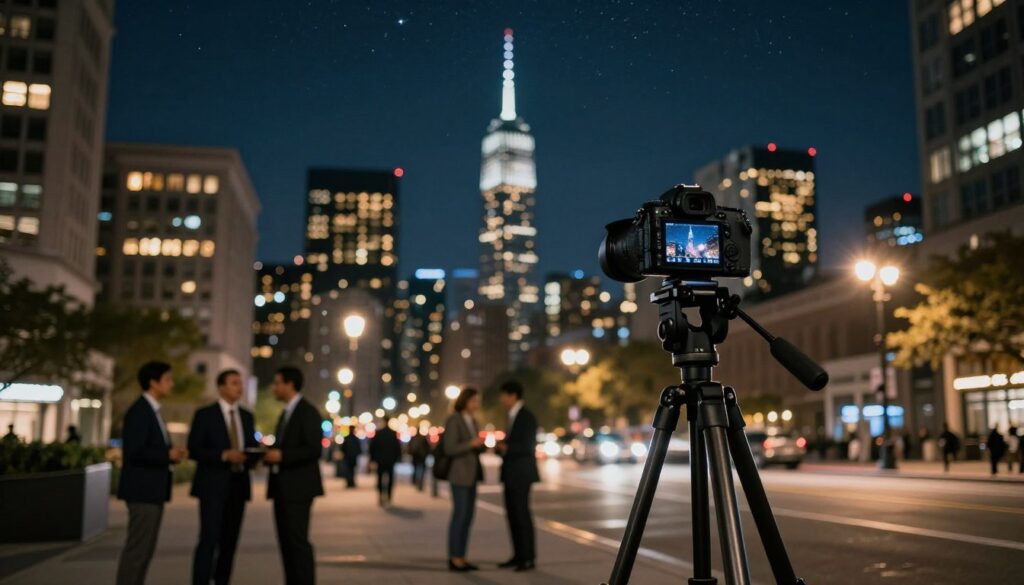
A good tripod lets me use a lower ISO and cleaner images with less digital noise. The tripod head matters too; precise framing in the dark depends on a smooth, locked head.
- Stability foundation: tripod + quality head = sharp long exposures.
- Vibration control: remote release and lens stabilization help, but the tripod is primary.
- Travel tips: choose durable, light gear to balance portability and performance over time.
| Item | Why it matters | What to Check |
|---|---|---|
| Tripod | Holds camera steady for long exposures | Leg stiffness, material (carbon fiber), weight |
| Tripod head | Precise framing and secure locking | Smooth pan/tilt, locking strength, detent quality |
| Remote release | Eliminates touch-induced vibration | Wired or wireless reliability and interval timing |
| Stability extras | Added resistance in windy or uneven conditions | Center hook, sandbag use, ground spikes |
Leveraging AI Software to Enhance Image Quality
Aiarty analyzes a frame and separates true texture from digital grain. That lets me clean up a noisy image without the smeared look traditional smoothing tools often leave.
| Use Case | What Aiarty Does | Benefit |
|---|---|---|
| Handheld night shots | Targets noise while preserving edges | Salvages frames shot at high ISO |
| Older sensor cameras | Enhances detail and lowers grain | Extends usable life of gear |
| Video recording in dim scenes | Frame-by-frame denoise with motion-aware smoothing | Cleaner footage, fewer retakes |
| Fast workflow | Batch processing and presets | Consistent results across shoots |
- Tip: Use AI after careful exposure and correct lens and autofocus choices — software is a powerful aid, not a substitute for good craft.
Must-Have Accessories for Night Shooters
Remote Shutter Releases
External Lighting Solutions
Protective Filters and Field Gear
- Spare batteries: cold air drains power fast—bring extras.
- Organized bag: protects the body, lens, and accessories on the move.
- Red lighting: preserves night vision for better framing and settings.
Balancing Budget and Performance
When funds are tight, choose a wide aperture lens before chasing extra megapixels. A faster lens lets you use lower ISO and improves autofocus in dim scenes.
- Entry-level bodies paired with a strong lens can produce pro-level photos when you master exposure and composition.
| Choice | Why it helps | When to pick it |
|---|---|---|
| New mid-range body + prime lens | Balanced performance and warranty | If you want current features and reliability |
| Used professional body | Higher sensor quality at lower price | If you want strong high-ISO performance |
| Entry body + fast zoom | Versatile framing with wide aperture | If you need flexibility for events |
Conclusion
Mastery of the best low light workflow blends equipment, timing, and creative risk. Keep experimenting; each session teaches something new.

The GBI LensLab Editorial Team publishes informational guides about cameras, lenses, image sensors, photography workflows, camera maintenance and digital imaging technology. Technical specifications are checked against manufacturer documentation and other appropriate primary sources when available.